AN OLYMPIC ATHLETE….WITH AN ASTERISK
For the first time ever, the U.S. Olympic Volleyball Team a berth in the Olympic Games. The year was 1980 and Debbie Landreth, now Debbie Landreth Brown, and her teammates were more than excited to be a trailblazing team in women’s sports and American volleyball. However, the dreams of her and her teammates of Olympic glory were dashed as the United States team boycotted the Moscow Games in response to the Soviet Invasion of Afghanistan. Featured in the book BOYCOTT: STOLEN DREAMS OF THE 1980 MOSCOW OLYMPIC GAMES, ($25.95, New Chapter Press, Landreth is proud of being on this historic team, but not competing due to the boycott makes here feel like an Olympian “with an asterisk.”
BOYCOTT: STOLEN DREAMS OF THE 1980 MOSCOW OLYMPIC GAMES, written by Tom and Jerry Carccioli, chronicles the stories of Landreth and her fellow Olympic team members who trained thousands of hours for their once-in-a-lifetime chance at Olympic glory in Moscow only to become pawns in a political Cold War chess match between superpowers. The book also outlines the Soviet invasion of Afghanistan that led to the boycott, efforts by some athletes to overturn to the boycott by legal means and the entire 1980 team’s eventual ceremonial gold. Former Vice President Walter F. Mondale wrote the book’s foreword.
BOYCOTT can be ordered from amazon.com here: http://www.amazon.com/Boycott-Stolen-Dreams-Moscow-Olympic/dp/0942257405/ref=sr_1_1?ie=UTF8&s=books&qid=1263615263&sr=8-1-catcorr). Landreth’s profile is featured below.
Debbie Landreth
Volleyball
“It was huge. Absolutely huge,” remembers women’s volleyball player Debbie Landreth, at the realization that the United States Olympic Committee had decided to vote against sending an Olympic team to the Summer Games in Moscow in 1980.
“It was one of those things where—leading up to the final decision—there was this hope that somehow the decision was going to be reversed and the boycott really wasn’t going to happen. It was crushing. It was devastating. We were on tour with the East Germans at the time. We had just finished playing a match and we found out about the decision and it was just so disappointing. Even though we knew there was a good likelihood of [boycotting], it’s one of those things where we couldn’t really prepare ourselves.”
Landreth was dumbfounded, as were the other 10 members of the first American women’s volleyball team to ever qualify for the Olympic Games. These volleyball pioneers had achieved a goal of qualifying for the Olympics by putting their lives on hold and moving to Colorado Springs as the first team to live and train fulltime at the United States Olympic Training Center, a former military training base which would become the USOC administrative headquarters in July 1978.
Landreth and her teammates had moved to the facility in the spring of ’78 and trained for half-a-year before embarking on a fall trip to the World Championships in the Soviet Union. “We had been together for only about six months and we ended up taking fifth at the World Championships,” recalls Landreth, now the women’s volleyball head coach at the University of Notre Dame. “It was a pretty big jump, and we realized if we were fifth at the World Championships, we could certainly be one of the top eight teams to qualify for the Olympics. The World Championships were bigger; it was 24 teams and we took fifth, [and] we knew the best teams in the world were playing there. We could see the tangible results with just six months of training and we knew we could do it.”
For Debbie Landreth, volleyball was not her first love. The thought of competing in an Olympic Games as a volleyball player was the furthest thing from her mind while growing up in El Segundo, Calif. The youngster was taken with softball and didn’t become interested in volleyball until high school. “I played volleyball, basketball and softball in high school,” Landreth recalls. “Between my sophomore and junior years, my high school volleyball coach, Barbara Bernlohr, asked me if I wanted to go to a volleyball camp in the summer. I thought that sounded fun so I went. That camp is what really ignited the fire within me to learn the sport of volleyball. I came back from that camp really excited and wanted to learn and get a lot better.”
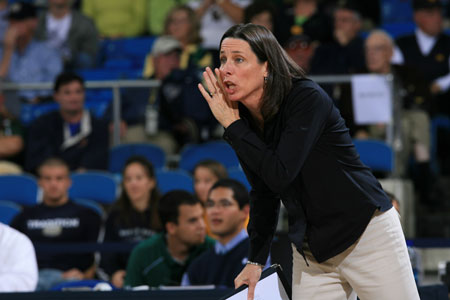
Debra Brown
Landreth’s natural athleticism combined with her new-found talent prompted her to ponder the possibility of someday making an Olympic team. “I think it was [during] the ’72 Olympics, but we didn’t have a team, she says. “USA didn’t qualify. I thought it would be really cool to be on a USA team. In high school, I had this little spark of thinking, ‘Wow, wouldn’t that be cool?’ But I never really knew how I would ever … It was a hope or dream that was never going to happen, but it was a nice thought.”
The reality of making an Olympic team really took shape during Landreth’s senior year in high school, when she made the junior national team. “It was … when I started training with them that I realized this might be a good way to develop my skills and really make it to the Olympics. It became something that I knew could happen, as opposed to before when it was just a dream.
“I don’t think my high school coach had any idea that I would take volleyball to the next level, but she was a good coach who wanted to give her players the best opportunity to learn more about the game. I think she knew I was an athlete who had some God-given talent and she wanted to help refine that. And, while my high school coach introduced me to the game and got me interested, it was Chuck Erbe, coach of the junior national team, who really taught me good, solid fundamental skills and gave me a solid foundation.”
Landreth’s path to the Olympics took a circuitous route after high school as she tried to balance the dream of competing at the highest level of her sport with securing an education for her life beyond the volleyball court.
Following high school, Landreth decided to attend El Camino Junior College. “I continued to train with the junior national team, and in the first semester, my first year out of high school, I had the opportunity to try out for the national team,” she says. “So, I tried out for the national team and made the roster for the 1974 World Championships. The national team was pretty lacking at the time. No full-time training. You tried out, they brought people in and you practiced for a couple weeks together and then played teams that were in year-round training programs. I made the team and went to the World Championships and had my 18th birthday in Mexico.We ended up taking 12th out of 24 teams.”
Only several years removed from her initial interest in the sport, Landreth was securely on the radar of USA Volleyball coaches. Knowing her Olympic dream was taking shape, she returned from the ’74 World Championships and re-enrolled at El Camino. “I knew the Olympics was something I wanted to do and I’d do whatever needed to be done training-wise to make it happen,” she says.
Landreth spent 1975 at El Camino before transferring to the University of Southern California, where she played two seasons with the Trojans. After helping lead USC to back-to-back national championships in 1976 and ’77, the two-time All-American opted to commit herself full-time to achieving her Olympic dream. “I left school to make it happen,” she says. “I didn’t graduate until after I finished playing for the national team. I graduated in ’82.”
Her Olympic vision came into clearer view during the 1979 Zonal Championships to qualify for the 1980 Summer Games. The American team knew they were on the right course after the 1978 World Championships and remained true to their “Aim For ’80” motto. “We knew going to the Zonal Championships that we could qualify by winning the whole thing—which is what we wanted to do—but also by finishing second,” Landreth explains. “We took second to Cuba. It was huge.”
The U.S. women’s volleyball team had qualified to participate in the Olympic Summer Games for the first time in their history. Debbie Landreth and her teammates had done it. Then after watching the U.S. hockey team’s inspirational win in Lake Placid, their motto became “Go For Gold.”
“Seeing the hockey team win, we thought, ‘That’s us! We’re winning a gold medal.’ All the notoriety they got was an awesome thing and that is what we were working towards,” Landreth recalls.
But America’s excitement about the Olympics was about to end.
“I do remember, specifically, that when we learned of [the possibility of a boycott] we thought it was an idle threat,” she says.“We were really confused and wondered why this would be something important for us to do as a country or as athletes. Really, what was it going to show? At first we thought, This isn’t really going to happen.[But] as the weeks and months went by, it became clearer and clearer that there was a really good likelihood the boycott would happen.”
As the reality of the political decision settled in, Landreth-Brown was faced with the uneasy decision whether to continue pursuing the next Olympiad in 1984, or to move on. “Yes, there was consideration,” she admits. “In the end I thought, I had the chance and now I’m moving in another direction.”
That direction involved heading to Arizona. After years of training, Landreth had to find a way to pay for her tuition. “I knew the coach at Arizona State University and talked to him about the possibility of receiving a grad-assistant position with him as an assistant coach and have my tuition paid for.” Head Coach Dale Flickinger enthusiastically welcomed Landreth, and thus began her coaching career with the Sun Devils and her farewell to her life as an Olympic hopeful.
“I think about the whole Olympic movement,” she reflects. “There are times when I think we were on the right track. We had prepared ourselves to go and compete at the highest level and give ourselves a chance to win a gold medal. I look back and think about what we could’ve done for the sport of volleyball at the time. What we could’ve done as a group collectively. It was a great story of people putting their lives on hold and saying, ‘Come on, let’s do this. We can do this.’ There was only one woman on the team who had finished college. All of us had dropped out, left families, all that stuff, on a very, very meager stipend—$80 a month. It never dawned on me that I was sacrificing so much. I was preparing for the Olympics.”
Asked what it means to be a member of the 1980 U.S. Olympic Summer Games team, Landreth pauses for a long time, and then confesses, “I don’t know.” She laughs uneasily and pauses again as she tries to further explain. “You know,” she finally says, “it’s something that I’m proud of and I feel blessed to have had the opportunity to play at the highest level and represent our country. While I know I was on the Olympic team according to the Olympic Committee and everyone else … it’s with an asterisk.
“It’s a different thing. Whenever somebody finds out I was on the Olympic team, they always ask, ‘Oh my gosh, what was it like?’ And nobody remembers that we didn’t even go. It’s like one of those things where they say, ‘You were on the Olympic team but you didn’t compete?’ It’s not really an Olympian, yet I know I am. It always has to be explained. That’s a bummer. It’s a bummer that I can’t just say, ‘Oh my gosh, it was awesome.’ And again, whether we had gone and won a medal or gone and fallen on our faces, the fact that we went and competed in the Games and represented our country, people want to hear about that stuff. I don’t really …” Landreth concludes—like so many of her 1980 Olympic teammates—with a loss for words that still confounds and confuses her as she tries to understand why her Olympic dream was stolen.


